Tuesday, July 7, 2015

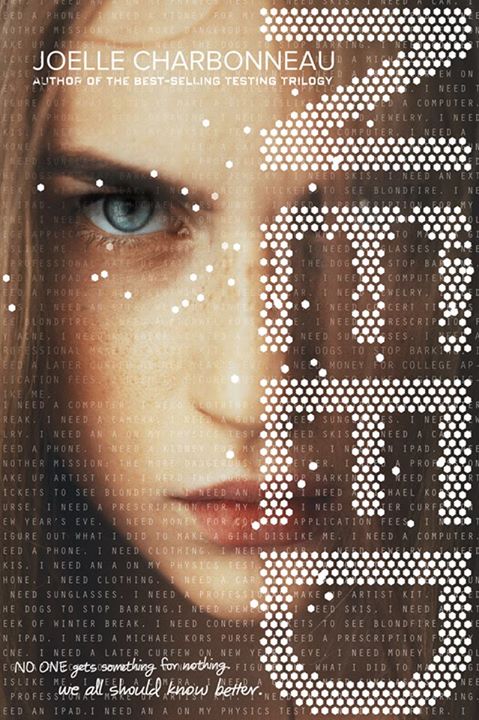
Need by Joelle Charbonneau


Three Stars!


The one-sentence summary? Need is a compelling thriller that explores social media and the impact of human needs and motivation. However, it's more than just a thriller or an exploration of teenage motivation. Given Charbonneau's previous dystopian trilogy, The Testing, I had expected a futuristic tale of subtle issues. This was certainly not the case with Need. Instead, Need is based in the present in a typical town with typical teenagers with typical issues, wants, and needs. It soon becomes apparent that "typical" won't continue.

Introduced as a fun game, an Internet activity rapidly engages the teenage population of an entire high school. It seems to start slowly, but the narration plays out the scenarios in a believable "real-time" manner. The story ramps up the fear factor and suspense quickly, all without excessive gore. Need aptly demonstrates the ease of how people are deluded into forgetting basic Internet safety protocols. Sadly, it also makes clear how easily teenage thought is dismissed by those in authority. It truly shows that there are consequences for every action no matter how inconsequential they seem at the time.

I particularly liked how the story unfolded. It seemed so very believable that I was totally caught up in the events as they were revealed. I also liked the voice of the female protagonist. She had her own worries: a missing dad and a brother who needed a kidney transplant along with a host of other typical teenage issues. Nonetheless, she maintained a strength of character throughout the novel even while dealing with some of her own internal flaws.

So why only 3 stars? Well, some of the secondary characters were a bit too stock for my taste: the thoughtless jock, the angst-ridden introvert, the psychopathic loner, the self-absorbed popular girl, etc. Also, while I enjoyed the overall plot, the ending was a bit too succinct. It was a quick ending that tied up the ends too neatly and especially too quickly. Basically, the pacing at the end needed more work. Otherwise, it was an engaging novel that explored some very real issues.

Enjoy the read, my friends.

Tuesday, June 23, 2015

The Accident Season by Moira Fowley-Doyle


Let's face it, the cover drew me in when I first saw it at BEA. A falling woman sinking into what? A woman thrown up by magical forces? Like many people, I both cringe and gawk at an accident, and this book drew me in like other "accidents." Once I entered the pages, I was both pleasantly confused and hooked into reading until the end. It's a terrific tale!

Magical Realism... This novel showcases the best aspects of the genre. It begins with a realistic accounting of a seemingly mundane lifestyle with a coincidental family issue. Every year, for about a month, the protagonist's family is prone to accidents; some are minor, but others are so horrific that they stain the future. Throughout the narrator's retelling of events, I was never quite sure if this really happened or if it was the imaginings of a young girl raised in an artistic (read eclectic) family. I think that enigma is what I truly enjoyed about the novel. At some points you say to yourself, "Hey, this is definitely a fantasy novel complete with fairies and witches and supernatural occurrences!" At other times, you convince yourself that these are just the wild imaginings of a deluded young woman. What I particularly loved is that while the ending clarifies many points from the novel, it still leaves the reader wondering which end is up.

The narrator's touching concern for her friends and a "missing" girl drive the plot and add intrigue to the seemingly normal events in her life. The dialogue flows easily and maintains an authentic presence. Vivid descriptions abound and add literary merit to the novel. The suspense builds gradually, but is nonetheless compelling. Many thematic topics are explored including loyalty, friendship, bravery, denial, drug use, secrets, and the paranormal.

Widespread inclusion and acceptance as normal of partying with smoking and drug and alcohol use suggest that it is not appropriate for a middle school audience, but is best suited for high schoolers and older. Adults will enjoy the tale as well!

Read on, my friends! This novel has my high regard.

Sunday, June 14, 2015

The Storm by Virginia Bergin (Book #2 in The Rain series)


Thanks to the ARC I received at BEA (with a different cover), I was able to continue reading the story of Ruby, a self-absorbed teen who is forced to deal with the complexities of a post-apocalyptic world. Ruby's life fell apart when a microbe arrived on Earth and contaminated ALL the water sources. While it did nothing to animals, people who came into contact with even a raindrop of water ended up dying a painfully horrific death. 

In the first book, H2O, Ruby is so unaware that she continues to care more about her outfits and makeup than finding food or nonhazardous beverages. Unlike the first story, Ruby now seems to be maturing a little bit. She still tells her story via a stream of consciousness narrative complete with side thoughts and splotched out expletives, but her concern for Princess necessarily forces her into a caregiver's role, albeit the bare minimum of care.


What did I like? The story seems to unfold naturally, complete with all the side jaunts and redirection one finds in a normal life. I also liked the way Ruby's relationships with other characters evolved. These were not perfect romances or sibling ideals. Rather, these were the odd connections that developed as a result of her new life circumstances, and that made the story more genuine and appealing.

What didn't I like? Ruby's character is still too whiny and self-absorbed. Plus, she glosses over scientific concepts critical to her survival with a childish indifference. However, if you can accept the totality of her teenage persona, you will definitely enjoy the tale.

Enjoy, my friends... But don't drink the water yet!

The Scorpion Rules by Erin Bow


OK, I'm a sucker for a good cover, and this one had me intrigued from the start: an obvious throne, the danger of a scorpion, and rules thrown in? I was immediately hooked. Add to that a terrific premise for a dystopian novel, and we're good to go. 

In this post-apocalyptic world, an artificial intelligence (AI) keeps order among mankind's warring countries/alliances, and it does so ruthlessly and almost cavalierly. After studying history, the AI determined that in order to prevent war, it must have a personal impact on those who make the decision to go to war. Thus, every nation's leader must give up his or her child to be a hostage. If no war ever happens, the children are raised peacefully in a monastery-like setting (a Precepture), and they are released at age 18. However, if a nation does declare war, the hostage child is immediately taken and killed. Hence, most leaders don't want to go to war. However, this is a post-apocalyptic world, after all, and resources are scarce, especially water. There is a constant tension of imminent war throughout the book.

The tension is increased for the hostage children in the Precepture, known as the Children of Peace. Not only do they have the obligation to remain royal in their everyday poise and conversation, they are expected to gracefully accept their impending deaths with dignity. That's a tall order for ones so young. Add to that the ever-present robotic proctors (spider-like, electric-prodding contraptions), and the AI teachers, and you quickly realize that even simple conversation among the children is highly structured and fiercely monitored. Any deviation from acceptable practice is punished swiftly. So when an outsider hostage child enters the mix after a change of leadership, things are necessarily thrown into disarray, and the plot thickens.

If it sounds this good, why only 3 stars? Well, it takes a LOOOONG time before you realize just how controlled the children must be in order to remain safe. Also, the narrator's description of the pastoral life led by the Children of Peace is extensive but rarely reveals any of the dangers the children face. It's too much description without enough clues about the danger. Once the situation changes, the pace picks up, but it's a long time coming. Also, I wasn't a big fan of the ending. It seemed a bit contrived and quick when compared with the pace in the beginning. It almost seemed like a different writer took over.

Overall, I do recommend the book. However, this is not a book for a reluctant reader looking for dystopian novels. It's a cross between 1984 and Thoreau's Walden Pond, and as such, requires a more inferential reader in order to grasp the inherent dysfunction in the system. This is not appropriate for lower middle school readers as there are several references to sex, but no outright descriptions other than kissing.

Enjoy, my friends!

Sunday, June 7, 2015

Six of Crows by Leigh Bardugo


After much anticipation, I was able to grab a copy of Six of Crows while at BEA2015 in NYC. The lines were long, so I knew that others shared my love of Leigh Bardugo's alternate Grisha world. This book definitely lived up to the hype, but first timers need to beware of a few things. 1. You really need to read at least the first book in the Grisha trilogy (Shadow and Bone) in order to understand some of the characters and the underlying conflicts present in Six of Crows. Grisha are a completely different type of being with seemingly supernatural powers and their own hierarchy and limitations. Reading Shadow and Bone will allow you to better understand this critical background before plunging into a world where this knowledge is taken for granted. 2. This book is set in the same world as the Grisha trilogy, albeit a different location, but it's flavor is totally different. This is not a book where the characters are fighting merely to survive. Rather, this is a book where the characters are fighting for a better future, and that's what I like about this book.

Faced with an impossible, almost Herculean, task, this team must somehow overcome their distrust of each other and utilize their unique gifts in order to succeed. However, as in real life, each character has some hidden, disabling secret that could jeopardize the job for all. It is this character background that gives the story its wonderful flavor and adds depth to each of the characters. Slowly revealed throughout the course of the novel, each new revelation not only makes sense and better explains what has happened before, but it also provides a new plot twist that complicates the future and the potential success of the "mission."

Bardugo's storytelling is compelling and her plot is masterfully confounding and simultaneously intriguing. The protagonist, Kaz, is a bottom dwelling con artist/trickster who has risen through the criminal ranks as a mastermind of planning and control. Just when you think you've figured out what is going to happen, Kaz flips you over and knocks you sideways. His planning genius and the related surprises make this story a true page-turner. I was hooked and unable to put it down until I finished it.

Also compelling were the characters themselves and the tenuous relationships they built with each other. There is a wraith of a spy, a sharpshooter with a gambling problem, a rich runaway, etc. Their disparate and unique abilities would ordinarily seem incongruous to a storyline, but Bardugo manages their interaction in a manner that seems real and not contrived. Their development just makes sense.

My only problem was my dismay at the ending. Clearly, there is a sequel forthcoming, but the ending was just not satisfying or compelling enough to keep me going. I'm a fan of Bardugo's storytelling, but lesser fans may be disappointed due to the sudden thud of the ending. Forewarned is forearmed, right?

My overall suggestion? Definitely read this book, but become familiar with the Grisha world first. Enjoy, my friends.

Sunday, May 31, 2015

After the Red Rain


After the Red Rain

by Barry Lyga, Peter Facinelli, and Robert DeFranco


I received an ARC of this book at BEA, and I was immediately drawn in. In fact, it was the first book I wanted to read of the many I had picked up while at BEA. The cover is the first clue that you are entering a post-apocalyptic world. The "cracked" letters and burning pile of debris let you know that this won't be a pretty picture. Indeed, that was certainly the case.

The prologue was creepy and a bit confusing, alluding to an earlier time frame, but it's connection doesn't become apparent until much later in the text. The today of the novel is a terrible potential future: humankind is impoverished, resources are scant, especially "natural" food, and people have been subjugated to the territorial magistrates, overlords who control work and the meager rations.

As is common in post-apocalyptic novels, one person stretches the rules to suit her own purposes. Deedra is an explorer who pushes the boundaries of acceptability in order to scavenge for items and food to supplement her rationed-near-starvation diet. While exploring, she encounters an almost perfect boy named Rose. Immediately, I assumed I would be reading a transgender tale of some sort, but that notion was quickly dispelled and much later replaced with the notion of transhuman.

Deedra's reaction to Rose and her subsequent actions propel the plot at a reckless speed that kept me rooted to turning pages without stopping. I felt her character had real truth. Hers was the outlook of a person who had been told this is the way it is and always has been. Yet in a world where history is a reflection of frequently edited wikis on the net, history is no longer fact, but a human construct of varying, and often conflicting, opinions. Deedra's hopelessness and despair reflect this mentality but seem to grasp for something more.

Stock characters abound, but they play their roles well and serve the overall plotline perfectly. My curiosity about this new world had me intrigued, but the later efforts at world building seemed stagnant and redundant. The strengths of this novel are its interesting observations about human nature in a post-apocalyptic world and its frenetic pace that keeps the reader engaged in the thrilling story. Some vocabulary is a bit high for most middle schoolers and even high schoolers, but overall it is a genuinely readable novel, enjoyable even for adults.

My final take? Go ahead and get it. It's worth the read!